

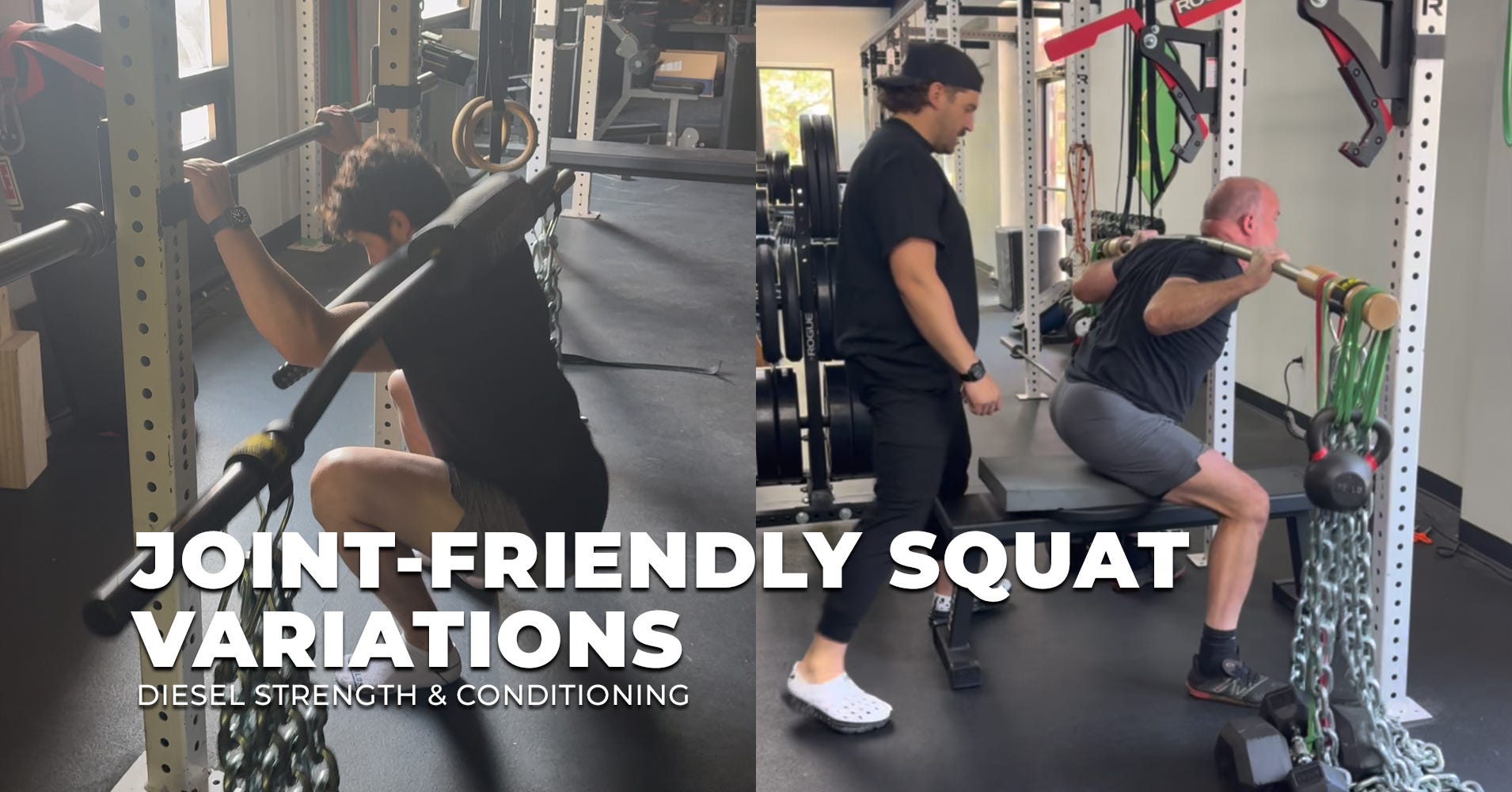
One of the most important principles that should guide every workout is finding exercises that feel good and work well for your body. This means selecting movement patterns, training implements, and exercise variations that align with your anatomy and joint structure while respecting your current injuries, weaknesses, and mobility restrictions.
For example, trying to perform a full-range, high-bar squat when you have meniscus issues, limited hip mobility, and/or long femurs that favor a more inclined torso position is often a poor fit. In this situation, you’re not respecting your anatomy, your leverages, or your current movement capabilities. Instead of forcing a specific exercise variation, choose one that allows you to train hard, move well, and stay pain-free.
“Good strength training is corrective.”
If an exercise feels good and you can load it with an appreciable weight, then there can be progression. And remember, over time with consistent integration of good technique, comprehensive warm-ups, and working to overcome your weaknesses/restrictions - strength training can be corrective. And more importantly, more training options (and exercise variations) will become available as your movement quality improves.
Pro Coaching Tip: The best squat variation is the one that allows you to perform the movement with optimal technique, the greatest pain-free range of motion, a good braced position, and consistent tension, stability, and control at every joint angle throughout the entire movement.
And here is perhaps the most important longevity lesson that nearly four decades in the gym has taught me: smoothness is the key to strength, control, and long-term joint health.
When a repetition is smooth, the muscles remain under tension throughout the entire movement, momentum is minimized, and the transitions between the eccentric (lowering), amortization (pause/reversal), and concentric (driving) phases are controlled and deliberate.
In my experience, the transition from the lowering phase back into the drive phase is where the joints are most susceptible to injury and excessive stress. Bouncing out of the bottom position in an attempt to create momentum and force the weight to lockout often does more harm than good.
“You want to get the most out of exercises. Don’t let them get the most out of you.” - Louie Simmons
So how do we “buffer” this transition? By utilizing accommodating resistance through bands, chains, and specialty bars. These tools help reduce the abrupt shift from lowering to driving the load, particularly when the joints are in their most vulnerable positions and weakest leverage angles. By smoothing out this transition, you can train harder, train longer, and continue making progress while keeping your joints healthy and pain-free.
In the pain-free squat variations below, you’ll notice we use a combination of several implements. The bamboo bar offers a “non-rigid” implement that flexes when we drive out of the hole and the chains deload at the bottom of the repetition. The bands help accumulate tension and force corrective posture with an overspeed eccentric loading. The safety squat bar (SSB) removes the shoulder external rotation component of a straight bar and using the rack for stability (Hatfield squats popularized by Dr. Fred Hatfield) provides stability and assistance in the hole. Again, the chains offer a deloading of the total weight in the weakest position of the lift.
Bamboo Squats with Chains & Bands
Recommend Volume: 3-10 sets x 1-5 reps
Hatfield SSB Squats with Chains
Recommend Volume: 3-10 sets x 1-5 reps
Try out this exercise variation in your next back workout and check out Ageless Athlete 5.0. It is my exact training blueprint for modifying conventional exercises (and programming) for older lifters to help them train optimally and for the rest of their life.